
Guide · Oct 20, 2026
OMAD Schedule: One Meal a Day Explained (Without the Hype)
OMAD means eating once a day in a window of about an hour. Here's what a real day looks like, what the few controlled studies measured, and who should skip it.
By the Ping Diet editorial team · Last updated
Short answer: OMAD, or one meal a day, means you eat all of your food in one sitting, usually inside a window of about an hour, and go roughly 23 hours without calories. It's the strictest of the common daily fasting schedules.
The controlled research on it is thin. The two trials we found that tested it directly were small, enrolled healthy adults, and ran 8 weeks and 11 days per diet. People in them could stick with it, but they were hungrier, and a few blood markers moved the wrong way. If you're curious, try two meals in a short window first.
Who should skip this: Johns Hopkins Medicine says intermittent fasting isn't for children and teens under 18, people who are pregnant or breastfeeding, people with type 1 diabetes who take insulin, or anyone with a history of eating disorders, and that everyone should talk to a doctor before starting [1]. OMAD is the most extreme version of that, so the same goes double. This page is general information, not medical advice.
What OMAD actually means
You'll see it written as 23:1. That's 23 hours of fasting and one hour of eating. In real life the window drifts. Some people give themselves two hours so dinner isn't a race, and the research below used windows of two to four hours.
In PingDiet terms, OMAD is one Ping a day. A Ping is any eating event: a meal, a snack, a latte, a handful of almonds while you cook. It's easy to rack up more of them than you'd guess. OMAD takes that down to one.
During the fast, you stick to drinks without calories. Hopkins lists water and zero-calorie drinks such as black coffee and tea as fine while fasting [1]. Milk, creamer and sugar are where it gets murky; our guide on whether coffee breaks a fast walks through each add-in, and the label checker helps with anything that comes in a package.
A sample OMAD day
Here's what a day looks like for someone who eats dinner at 6 PM. Swap the times to suit your work and family.
| Time | What happens |
|---|---|
| 7:00 AM | Water. Black coffee or plain tea if you drink it. |
| 10:00 AM to 5:00 PM | Water, plain tea or black coffee. No snacks, no cream. |
| 6:00 PM | The one meal starts. |
| 7:00 PM | Kitchen closes. The fast starts again. |
| Next day, 6:00 PM | Next meal, about 23 hours later. |
Evening is a common choice because it lines up with family dinner. In the 2007 USDA trial below, the single meal was eaten between 4 and 8 PM [3]; in the 2022 trial, between 5 and 7 PM [4]. If you'd rather eat at lunch, the eating window calculator will work out your hours for any start time.
What goes on the plate
This is the hard part. One meal has to cover a whole day, so it has to be bigger than a normal dinner, but Hopkins also warns that packing your eating time with high-calorie food or a much larger volume than you usually eat works against you [1]. Those two things pull against each other, and that tension is most of what makes OMAD tricky.
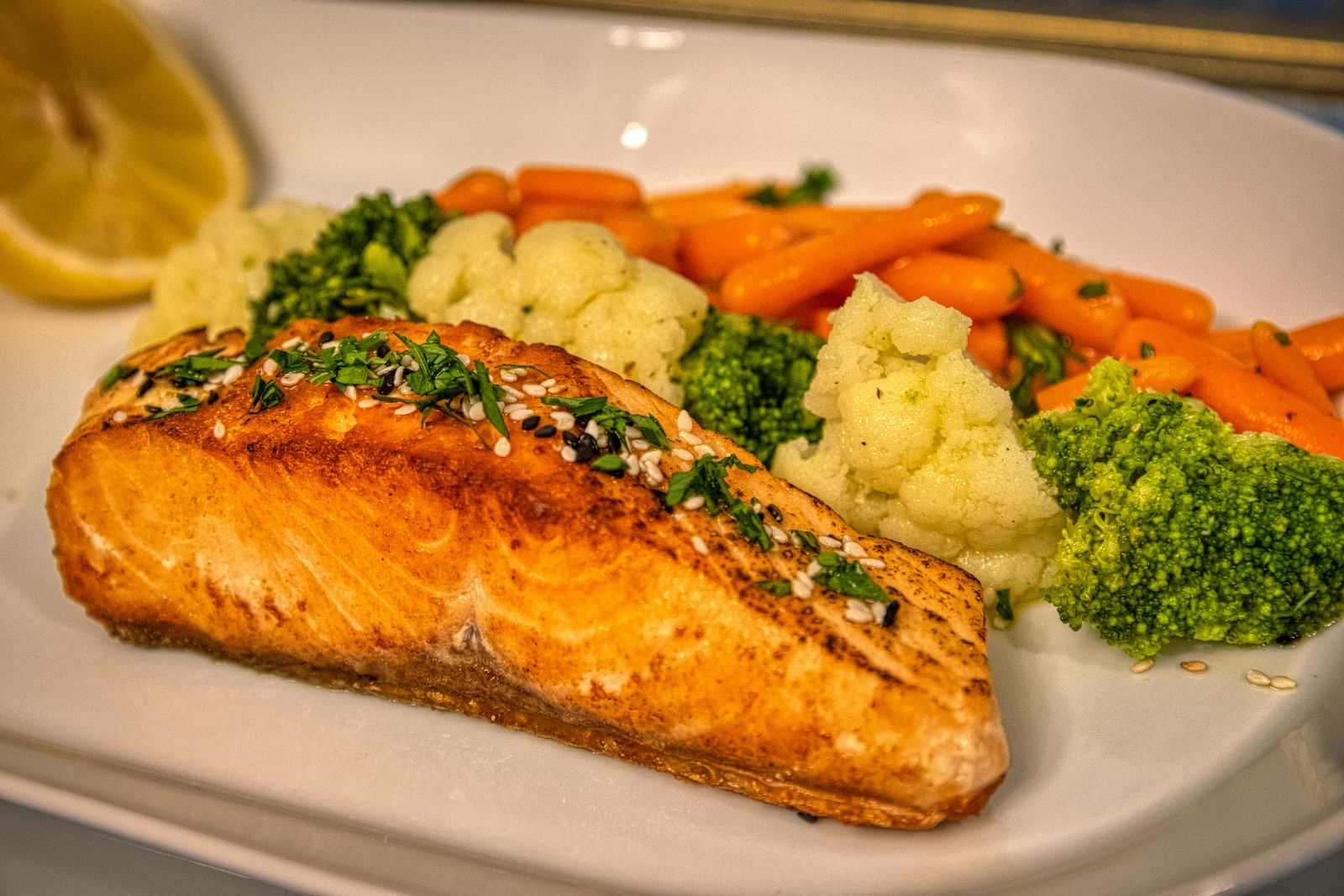
A plate that holds up looks like a large, ordinary dinner rather than a feast. Think a salmon fillet or a couple of chicken thighs, a real portion of rice or potatoes, a pile of roasted vegetables, a salad dressed with olive oil, and fruit or yogurt afterward. Hopkins points to the Mediterranean diet as a good blueprint for what to eat whether you fast or not [1].
If you've never seen what a full day of food looks like on one plate, a cheap digital kitchen scale used for a week will teach you more than any app. And since you'll be drinking a lot of water between meals, a large insulated water bottle you can keep on your desk makes the long stretch easier to manage.
What the studies found
There isn't much, and what there is was done in small groups of healthy, normal-weight adults.
The USDA and National Institute on Aging trial (2007). Healthy middle-aged adults ate all the calories they needed to hold their weight, either as three meals a day or one, for 8 weeks each. On one meal a day, they reported significantly more hunger. Their body composition shifted, with a drop in fat mass, but their blood pressure and their total, LDL and HDL cholesterol went up [2].
A second paper from the same trial found higher morning fasting blood sugar and a slower insulin response in a morning glucose test while people were on one meal a day; those changes reversed after the diet ended [3].
The Amsterdam and Oslo trial (2022). Eleven lean adults finished a crossover study where they ate the same calories either as three meals or as one meal between 5 and 7 PM, for 11 days each. Strength and aerobic capacity held steady on one meal a day [4].
Those are the two controlled trials we found that compare one meal a day with three meals at the same calories. Neither ran longer than 8 weeks per diet, and neither studied people with health conditions or people doing OMAD for months or years. So when you see bold promises about OMAD, keep in mind how small the pile of evidence underneath them is.
OMAD vs 16:8 and 18:6
16:8 gives you an 8-hour eating window and usually two or three meals. 18:6 shrinks that to 6 hours and two meals. OMAD drops to one. Our 16:8 vs 18:6 vs OMAD comparison goes through the trials on each, but the short version is that, in the trials covered there, longer daily fasts haven't reliably beaten shorter ones, and the shorter schedules are a lot easier to live with.
If what draws you to OMAD is the simplicity of not thinking about food all day, two meals in a 6-hour window gets you most of that with fewer downsides.
How to try it without going all in
- Start smaller. Do 12 or 14 hours of overnight fasting for a week or two. Hopkins notes it can take two to four weeks for the body to get used to intermittent fasting, and you may feel hungry or cranky in that stretch [1].
- Move to 16:8, then two meals. Get comfortable with a two-meal day before you drop to one.
- Try OMAD on one or two days a week, not every day. A busy Tuesday is a good test.
- Watch how you feel. Hopkins says to talk to your doctor if you notice unusual anxiety, headaches, nausea or other symptoms after you start [1].
- Check your medications. If you take anything that has to be taken with food, or anything for blood sugar or blood pressure, ask your doctor before changing when you eat.
Sources
- Johns Hopkins Medicine. Intermittent Fasting: What Is It, and How Does It Work? Updated April 7, 2026. https://www.hopkinsmedicine.org/health/wellness-and-prevention/intermittent-fasting-what-is-it-and-how-does-it-work
- Stote KS, et al. A controlled trial of reduced meal frequency without caloric restriction in healthy, normal-weight, middle-aged adults. Am J Clin Nutr. 2007;85(4):981-988. https://pubmed.ncbi.nlm.nih.gov/17413096/
- Carlson O, et al. Impact of reduced meal frequency without caloric restriction on glucose regulation in healthy, normal-weight middle-aged men and women. Metabolism. 2007;56(12):1729-1734. https://pubmed.ncbi.nlm.nih.gov/17998028/
- Meessen ECE, et al. Differential effects of one meal per day in the evening on metabolic health and physical performance in lean individuals. Front Physiol. 2022;12:771944. https://pubmed.ncbi.nlm.nih.gov/35087416/
Frequently asked questions
What can I drink during the OMAD fast?
Drinks without calories. Johns Hopkins Medicine lists water and zero-calorie drinks such as black coffee and tea as fine while fasting. Milk, creamer and sugar add calories.
How long is the OMAD eating window?
About an hour in the strict 23:1 version. Many people allow two hours, and the controlled studies used windows of two to four hours in the late afternoon or evening.
Is OMAD safe long term?
Nobody knows yet. The controlled trials we found ran 11 days and 8 weeks per diet in small groups of healthy adults. Talk to your doctor before trying it, and skip it if you are under 18, pregnant or breastfeeding, take insulin for type 1 diabetes, or have a history of eating disorders.
Can you build muscle on OMAD?
There isn't good data. In one 11-day trial of 11 lean adults, strength and aerobic capacity held steady on one meal a day, but that study was too short to say anything about building muscle.
What does a typical OMAD meal look like?
A large, ordinary dinner: a protein such as fish or chicken, a starch such as rice or potatoes, plenty of vegetables, some olive oil, and fruit or yogurt afterward.